What genetics taught me about TEA AND sensitivity, AND WHY ICE BATHS, VIPASSANA AND BREATHWORK MIGHT NOT BE GOOD FOR YOU
Recently I have been playing with my genetics information and AI. This exploration was prompted by a conversation I had with a tea friend who shared that she had histamine sensitivity. That made me reflect on my own experience — that ever since early childhood I have been sensitive to almost everything, with a strong aversion to most foods on the high-histamine list.
For some people histamine sensitivity is acquired, for others it is genetic - you are born with it, and there is very little you can do beyond reducing the daily load.
So I checked the gene for histamine sensitivity. I did a 23andMe genetic report fourteen years ago and still have the raw data, and the result was not surprising - I have it.
I have done many tests throughout my life, and they always came back with long lists of foods I “shouldn’t” eat - much longer than the list of foods considered safe. But I never really understood why. I was also told that if I stopped eating those foods for a while, I would eventually tolerate them again, which was never the case.
Mainstream medicine, of course, did not help with this understanding. In fact, since none of the traditional allergy tests came back positive, I was told it was probably “in my head”.
How typical.
Anyway, this is not what I came here to tell you about.
That first inquiry opened a Pandora’s box. I started checking many different genes, related to many aspects of my health and life, and a completely new understanding of how I operate — and why things are the way they are - began to emerge.
Most of these things are not necessarily because of my lifestyle or traumas (although of course those matter too). The baseline is genetic. I was born highly sensitive, and life’s experiences only amplified it even more.
(Side note: everything Human Design says about my design correlates with my genetic information. How interesting is that?)
One surprising discovery was related to magnesium. While most people are calmed by it, I am activated by it. Instead of restful sleep, my whole body starts pulsing, and my heartbeat oscillates between loud and quiet all throughout the night.
Yes - this, too, is genetic.
Was anyone ever able to explain this reaction to me before? No.
But my genome report and AI could.
Genetics also gave me a nuanced insight into my hair loss. I finally understood why it is happening, what I can do about it - and the solution I started implementing has already begun to work.
They also explained why romantic relationships and motherhood have been so challenging for me. And it is not because of an avoidant attachment style. My relational wiring, apparently, is closer to a monastic one.
I also have a highly sensitive, refined, and finely attuned nervous system, along with mast cells that are easily activated. This means high sensory acuity, fast threat detection, and strong interoception. I feel things deeply in my body.
From childhood, the world of smells and sounds felt overwhelming. Combined with histamine sensitivity, I was constantly caught in a loop of mast cell activation.
And the thing is - I still am.
This is neurophysiology, not psychology, in my case. Things overwhelm me easily. My system is wired toward predictability, safety, and interoception. My healing and spiritual path needs to happen slowly, safely, and gently - not in a cathartic, dramatic way.
Genetically.
This made me reflect on how healing is often presented as if it should look the same for everyone.
Many people confuse dysregulation with healing.
For sensitive nervous systems:
intensity ≠ healing
vibration ≠ regulation
catharsis ≠ release
Sensitive systems heal through predictability, slowness, gentleness, safety, and orientation — not through overwhelm.
Many people believe that the more intense the experience — the more shaking, screaming, crying, and releasing - the deeper the healing. For some, maybe. For many others, no.
In fact, such practices can create more harm than good.
In my case, intense breathwork, cold plunges and ice baths, kundalini yoga, and even Vipassana-style sitting still for hours can be activating. Visualisations, affirmations, and drawing are also activating, because they feel forced and controlled.
My system does not want to imagine, force, or control.
It wants to FEEL.
You might be wondering about Vipassana.
Vipassana teaches one to watch sensations neutrally and without judgment. But this is not true healing. Healing happens when we actually feel sensations deeply and develop a cognitive understanding of whether they are pleasant or unpleasant. This trains the body to recognise what is good or harmful for us - and perhaps to leave a person, a job, a place, or a food.
Sitting in stillness for hours is not natural for most human beings. It can trap emotional expression. If the body feels pain or discomfort, why not change position? We need to love the body, because we are the body - not torture it..
Vipassana does not build capacity to feel within safety. It teaches endurance within a highly controlled environment, without taking into account that some people do not yet have the internal safety to sit with what arises. When returning to everyday life, sensitive people can feel even more overwhelmed - and the Vipassana tools often do not help.
Vipassana teachers and volunteers are not trained in trauma or psychology. When difficult experiences arise, the answer is often simply: “Meditate more.” That does not feel like a safe or informed environment.
That said, I am still grateful to Vipassana - for understanding the cycle of thoughts, emotions and sensations and how to stop it, and for the silence and rest fit offered me rom motherhood and daily demands. And yet, for sensitive nervous system this path alone is insufficient
For me, nervous system work, somatic experiencing - and (!!) the way of tea — are ideal.
How interesting that I intuitively gravitated toward them!
The Way of Tea feels particularly supportive for sensitive individuals. Perhaps that is why the tea community is full of them.
Tea is simple - the setting does not overwhelm, it supports.
Tea is not goal-oriented, it is an “aimless activity”, we drink tea for the sake of drinking tea.
It feels effortless and enjoyable, never forced.
Tea is not about achieving states. Presence itself is enough.
Tea is devotional. It directs attention away from us and toward something greater. Reverence, beauty, love, trust, and offering - all of these create safety.
Because of sensitivity, rushed, cluttered, loud, and bright environments can be deeply dysregulating. Many wellbeing events - with tight schedules, no silence between words, and no space to pause - are actually triggering rather than healing.
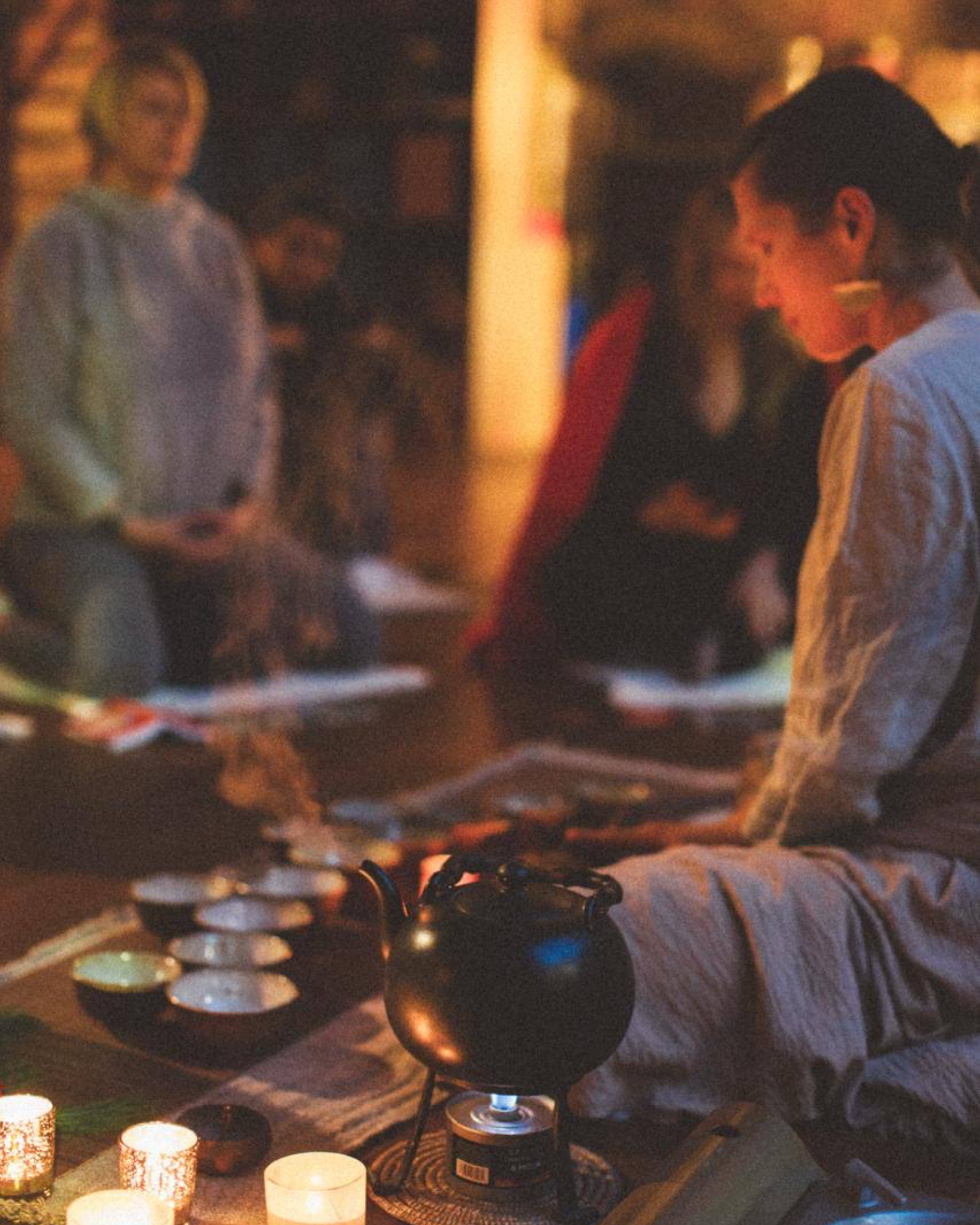
Tea ceremony spaces, by contrast, exude harmony, beauty, and subtlety. They are designed to regulate, to evoke quiet, and to allow us to experience the world as it is - without filters. For sensitive people, this can be deeply comforting.
Of course, for me this also means being careful with aged and fermented teas (like shou puerh or aged sheng), as they are high in histamine. Interestingly, I only drink them with others, never alone — as if being surrounded by guests without histamine sensitivity to it supports my own.
What I am ultimately pointing toward is this: know yourself. Truly.
With self-knowledge comes great acceptance — and trust.
How often do we force ourselves into experiences simply because a teacher or facilitator tells us they are healing? Because “everyone says so”? In doing that, we often betray our own unique system.
Ideally, everyone would be attuned enough to choose intuitively. But many people are disconnected from their bodies and rely instead on experts and trends.
Take ice baths, for example. On one end of the spectrum, Wim Hof says everyone should do them. On the other, Chinese Medicine says no one should. The truth, as always, is in the middle.
It depends on you - your constitution, your type, your genes, your nervous system. For many people, ice baths have an extreme cooling and damaging effect, yet they are practiced blindly. Unless you are a very Yang, fiery type, it might be wise to stay away.
Knowing your genetics is one way — not the only way — to approach this wisely.
To me, this feels like the future of medicine: a personalised, tailored approach to supplements, therapy, sensitivities, practices, and even spiritual paths.
Yes, genetics is mind information. Ideally, we would listen directly to the body. But in a society so disconnected from bodily intelligence, understanding which practices and foods are right for you can reduce harm, inflammation, and re-traumatisation.
More safety earlier on.
And from there, true listening may begin.